.png)

Understanding Real Ear Measurements and Why They Matter
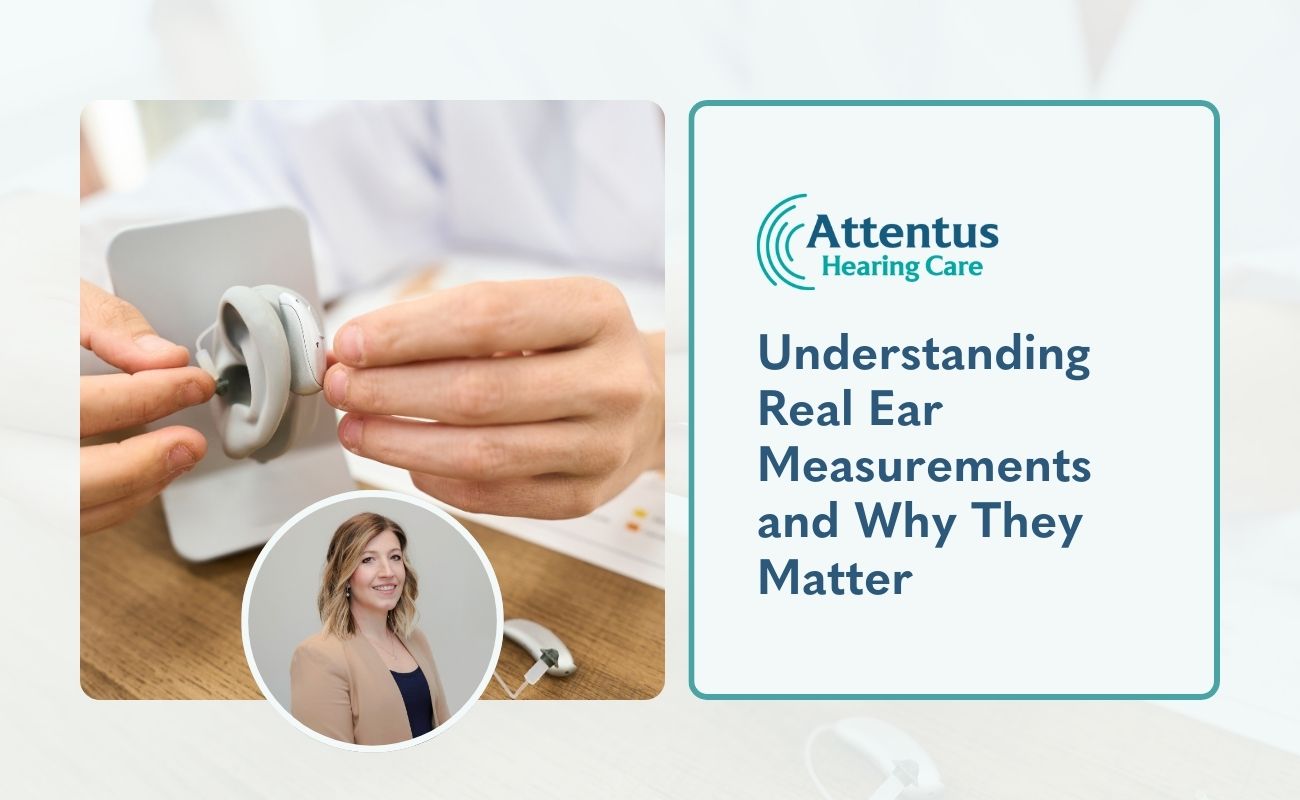
Real Ear Measurement (REM) is the gold standard for hearing aid fitting, yet studies show that only about 30% of hearing care providers actually use this critical verification tool. At Attentus Hearing Care, we believe every patient deserves the precise, evidence-based care that REM provides—which is why we use it for every hearing aid fitting at our New Britain clinic.
What Is Real Ear Measurement?
Real Ear Measurement is a verification procedure that measures the exact sound levels your hearing aids deliver inside your unique ear canal. Using a thin probe microphone placed in your ear alongside your hearing aid, this technology captures real-time data about how sound is amplified for your specific ear anatomy and hearing loss pattern.
Unlike generic programming based on average ear canal dimensions, REM accounts for the individual variations that significantly affect how hearing aids perform. Your ear canal shape, size, and resonance characteristics all influence how sound reaches your eardrum—and REM ensures your devices are programmed precisely for your ears, not someone else's.
The Science Behind REM
When audiologists program hearing aids without REM, they rely on manufacturer targets based on average ear measurements. However, research consistently demonstrates that these "first fit" settings often miss the mark by significant margins. One person's ear canal might amplify high frequencies naturally, while another's might dampen them. These differences can result in under-amplification or over-amplification of specific frequencies, directly impacting your ability to understand speech.
REM removes this guesswork. By measuring the actual output in your ear canal, we can see whether your hearing aids are delivering the prescribed amplification at every frequency where you have hearing loss. This precision leads to better speech understanding, particularly in challenging listening environments like restaurants or group conversations.
Studies published in audiology journals repeatedly confirm that REM-verified fittings produce superior outcomes compared to fittings without verification. Patients fitted with REM report higher satisfaction, better speech recognition scores, and increased hearing aid usage. The data is clear: verification matters.
How Real Ear Measurement Works
The REM process adds just 15-20 minutes to your hearing aid fitting appointment, but the benefits last throughout your entire experience with your devices. Here's what happens during a Real Ear Measurement session:
First, we measure your ear canal's natural resonance without hearing aids. This baseline tells us how your ear naturally amplifies sound before any hearing aid intervention. Next, we place a thin probe tube in your ear canal along with your hearing aid. The probe microphone sits near your eardrum, positioned to measure the actual sound levels reaching that critical location.
We then present calibrated speech signals at different volume levels—soft, moderate, and loud—while measuring how your hearing aids respond. The equipment displays real-time graphs comparing the measured output to your prescribed targets based on your specific hearing loss. If there are discrepancies, we make precise programming adjustments and verify them immediately.
This process repeats for each ear and may involve testing in different hearing aid programs or settings. The result is a fitting customized to your individual anatomy and hearing needs, not just manufacturer defaults.
Why Some Providers Skip REM
Despite overwhelming evidence supporting REM, many hearing care providers don't use it. The reasons vary: some lack the necessary equipment, which represents a significant investment. Others claim they don't have time for the additional 15-20 minutes per fitting. Some providers simply weren't trained in REM protocols during their education.
This gap in care quality concerns us. When patients invest in hearing aids—often spending thousands of dollars—they deserve the assurance that their devices are programmed correctly. Without REM, fittings rely on guesswork and patient feedback alone, which can miss subtle but important problems with amplification levels.
At our New Britain clinic near Doylestown, we've made the commitment to evidence-based practices including REM for every fitting. We believe this level of care should be standard, not exceptional.
The Benefits of REM-Verified Fittings
Patients who receive REM-verified fittings experience measurable advantages. Speech understanding in noise improves because the precise amplification ensures that consonants—the building blocks of speech clarity—receive adequate but not excessive amplification. This balance is nearly impossible to achieve through subjective adjustments alone.
Comfort improves as well. Over-amplification, even in specific frequency ranges, causes listening fatigue and can make hearing aids uncomfortable to wear. REM helps us avoid these issues by ensuring appropriate output levels across all frequencies and volume settings.
Long-term success with hearing aids also increases with REM. When devices are properly fitted from the start, patients adapt more quickly and are more likely to wear their hearing aids consistently. This consistent use leads to better auditory system stimulation and improved brain processing of sound over time.
REM and Different Hearing Aid Styles
Real Ear Measurement works with all hearing aid styles we fit at Attentus Hearing Care, including the popular receiver-in-canal (RIC) models we offer from Phonak, Oticon, Starkey, Signia, and Widex. Whether you're fitted with the advanced Phonak Infinio Sphere with its dual-chip architecture, the Oticon Intent with BrainHearing technology, or the Starkey Omega AI with DNN 360 directionality, REM ensures these sophisticated features deliver their intended benefits for your specific hearing needs.
Custom devices like in-the-ear or completely-in-canal styles also benefit from REM verification. These devices sit deeper in the ear canal, making accurate programming even more dependent on individual ear canal characteristics.
What to Expect During Your REM Fitting
When you schedule a hearing aid fitting at our New Britain clinic, REM verification is included as part of our comprehensive service. The probe tube placement is painless and most patients barely notice it's there during testing. We explain each step of the process and show you the real-time measurements on screen, so you can see exactly how your hearing aids are performing.
After the initial REM session, we program your devices with the precise adjustments needed. We then verify these changes with additional measurements to confirm accuracy. This iterative process ensures optimal results before you leave our office.
Schedule Your REM-Verified Hearing Aid Fitting
Our audiologist at Attentus Hearing Care brings advanced expertise and commitment to evidence-based practices to every appointment. Our New Britain clinic, conveniently located near Doylestown, is equipped with the latest Real Ear Measurement technology and serves patients throughout Bucks and Montgomery counties.
Whether you're new to hearing aids or considering an upgrade from older devices, we invite you to experience the difference that proper verification makes. Contact us at 267-669-1345 to schedule your comprehensive hearing evaluation and learn more about our REM-verified fitting process. Your hearing deserves this level of precision and care.
